
"Let us know if you see any good deals." Sound familiar?
We often get the question: "Can you let us know if you see any good deals?" You may have said it yourself, or heard it from a colleague.
It sounds proactive. It feels like deal sourcing is top of mind. In reality, it often means something else entirely. It means you are waiting.
And while you are waiting, your competitor is having dinner with a founder eighteen months before any formal process begins. They are not reviewing a teaser. They are discussing succession. Ambition. Timing. Doubts. No banker involved.
Your pipeline tells a different story. High volume. Competitive processes. Incredible effort to stay in the running. But rarely the kind of company that makes a fund.
The real question is not whether your pipeline is large enough. It is whether the deals that actually matter ever reach it.
And if they do not, is that a sourcing problem, or a positioning problem?
Sourcing Positioning Matrix: Where does your deal flow come from?
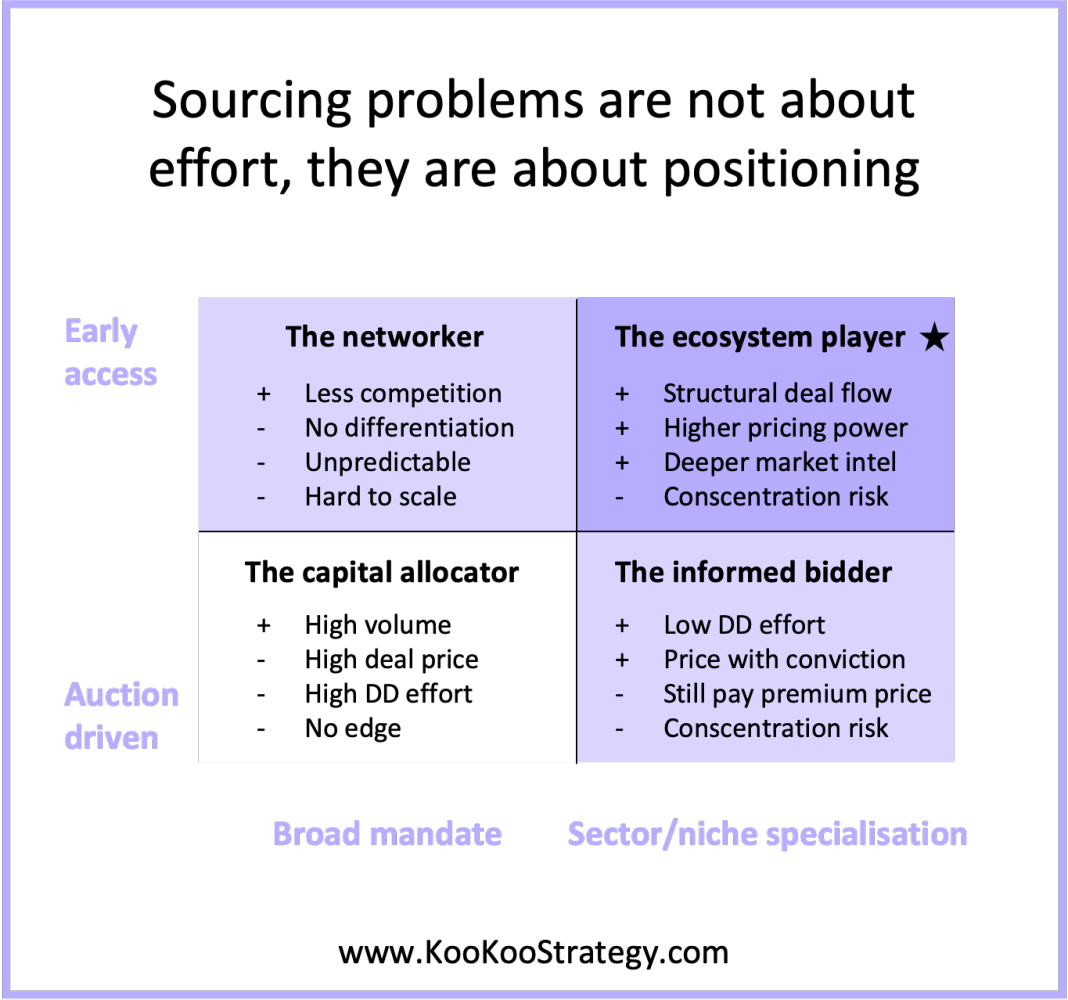
Sourcing Positioning Matrix.Kookoo Strategy
Before you place yourself on the matrix, answer these four questions honestly. They reveal more about your sourcing position than any pipeline report.
Where did my last three completed deals come from?
How often am I referred by my network to a new deal opportunity?
Do people in my target market know what I stand for?
When do CEOs and founders reach out to me for advice, and on what topics?
If most of your answers point to bankers, brokers, and competitive processes, you are not in the top right of the matrix. That is not a judgment. It is the starting point for a different conversation.
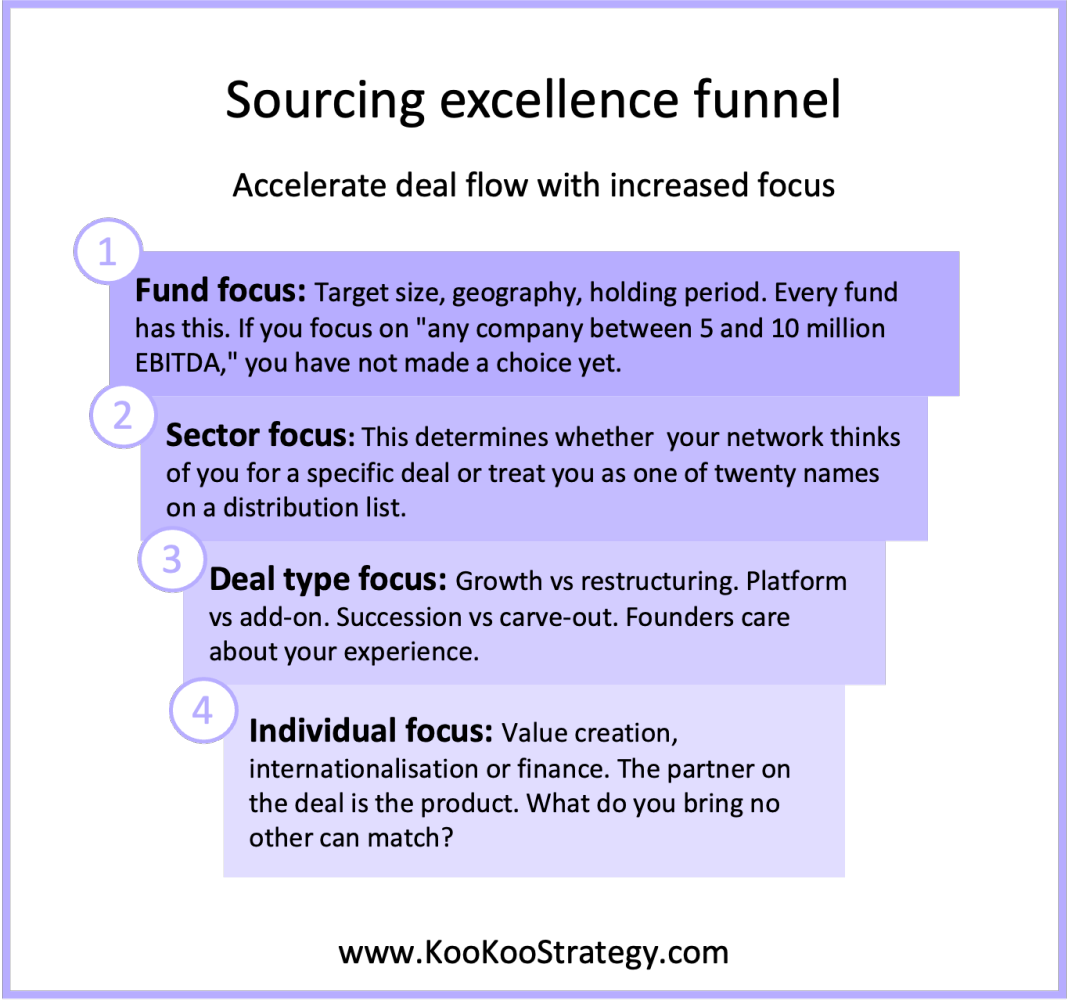
Positioning funnel: four levels that determine where your deals come from
Most sourcing problems are not about effort. They are about positioning. And positioning is not one decision. It is a sequence of four choices, each narrowing your focus and sharpening your edge.
Source Excellence Funnel.Kookoo Strategy
Level 1 is comfortable because it keeps options open. Level 2 forces you to say no to sectors. Level 3 forces you to build a reputation around a specific type of transaction. Level 4 forces you to be honest about what you personally bring beyond capital.
Most sourcing strategies stall because the fund has clarity at level 1 but ambiguity at levels 2, 3 and 4. The deals that define a portfolio go to investors who are sharp at all four. Where do you see room for improvement?
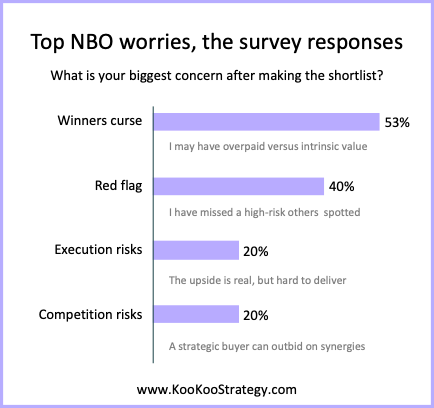
What your peers told us: top NBO worries after making the shortlist
Top NBO Worries.Kookoo Strategy
We asked investment professionals one question: what is your biggest concern after making it to the shortlist?
Winner's curse (53%): I may have overpaid versus intrinsic value
Red flag risk (40%): I might have missed a critical issue others already spotted
Execution risk (20%): The upside is real, but hard to deliver post close
Competitive risk (20%): A strategic buyer can outbid on synergies I cannot match
Over half of our respondents worry most about overpaying. Not about execution. Not about competition. About price. It's an uncertainty problem disguised as a valuation problem. When you move through a competitive process, you are making high-stakes decisions with incomplete information, compressed timelines, and limited access to the people who know the business best.
The winner's curse is not by definition a valuation failure. It is what happens when conviction is built on assumptions rather than evidence. The investors who worry least about overpaying are the ones who had the time and access to turn uncertainty into insight before the pressure started.
Want to pressure test your budget before committing to a full DD budget?
We run a 30-minute deal conviction check with investment teams. No pitch. No deck. Just an honest conversation about the deal you are currently evaluating: where the thesis is strong, where the gaps are, and whether the commercial upside holds up under IC feedback.